A spot exchange with its own liquidity engine.
Trading terminal, Easy Trade, Launchpad, Earn, native apps and a 53-screen operations console. Order books on 97 markets come from the Mirror engine, which quotes real, executable prices without tying up your capital and hedges every fill the moment it happens.
- mirrored markets
- 97
- blockchains
- 9
- listed assets
- 45+
- customer languages · TR EN PL
- 3
Watch the exchange run.
Markets, the pro terminal, Easy Trade and Launchpad, recorded on the running system under a neutral brand.
Recorded on the live system; some figures are sample data. Captions in English.
One product. Four layers.
Everything below ships with the Exchange block. Modules marked optional are priced separately in the configurator; each console is the admin side of its module.
The face the customer sees.
Spot trading terminal, market pages, crypto purchase flow, launchpad and academy. Live order book and trade feed over WebSocket.
Trading terminal
Limit, market and stop-limit orders. Live order book, depth view, recent trades and TradingView charting on one screen, with a live price ticker across the top.
Market pages
A price chart for every asset, 7D/30D/90D/1Y change, an asset overview and a direct link into trading. The pages also produce content for search engines.
Two trading modes
Easy buy/sell for people who do not want the order book, and the full terminal for people who do. Both trade against the same liquidity.
Multiple languages
TR / EN / PL today; Arabic and Russian on request. The language choice persists and server-side SEO titles are translated too.
Asset listing application
Project owners submit a listing request from the site; requests land in a queue in the admin panel.
Sign-up and sign-in
Email and password with 2FA. Email verification works with either a link or a 6-digit code.
Trading, markets, listing.
Screens from the running system. Light theme.
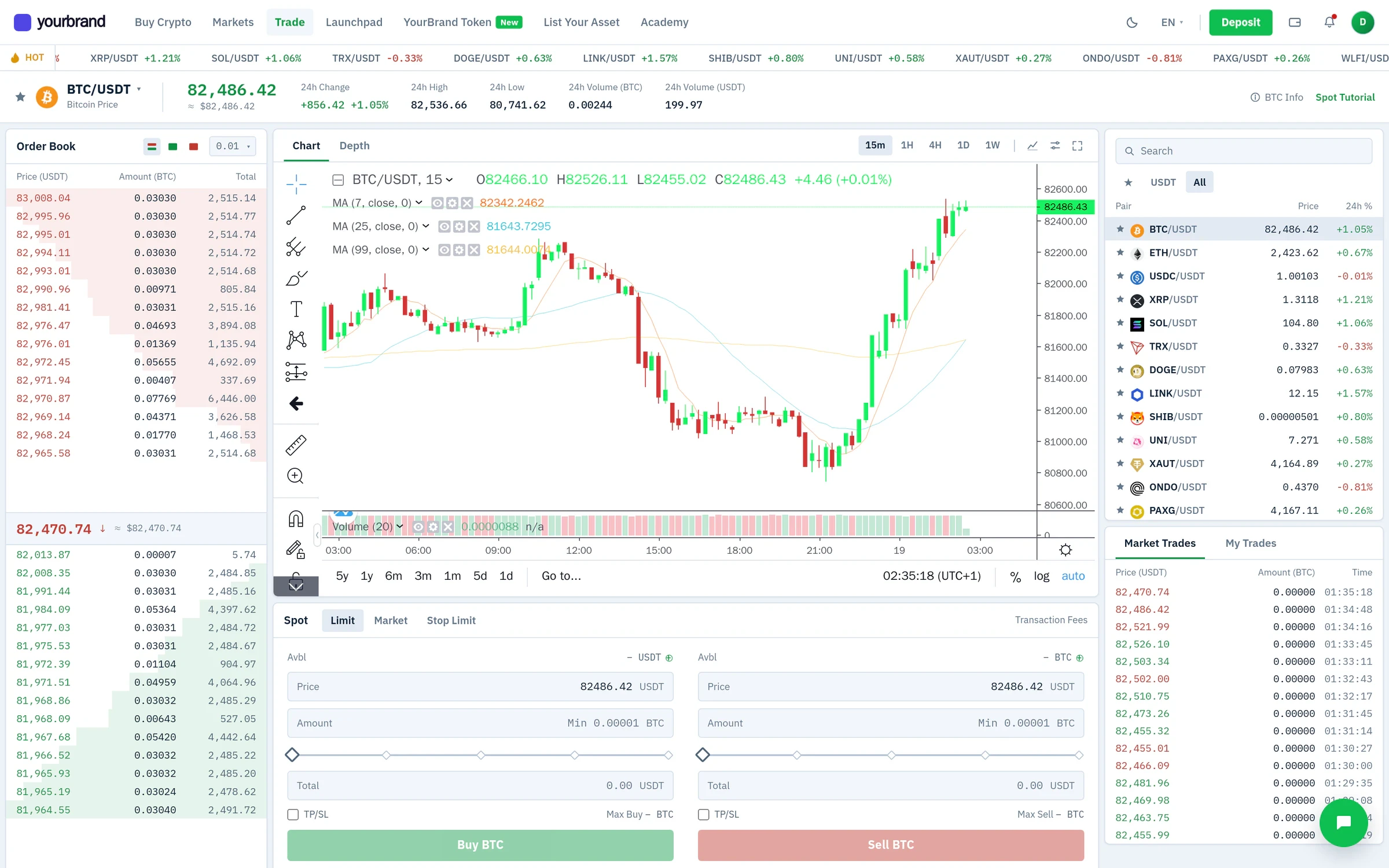
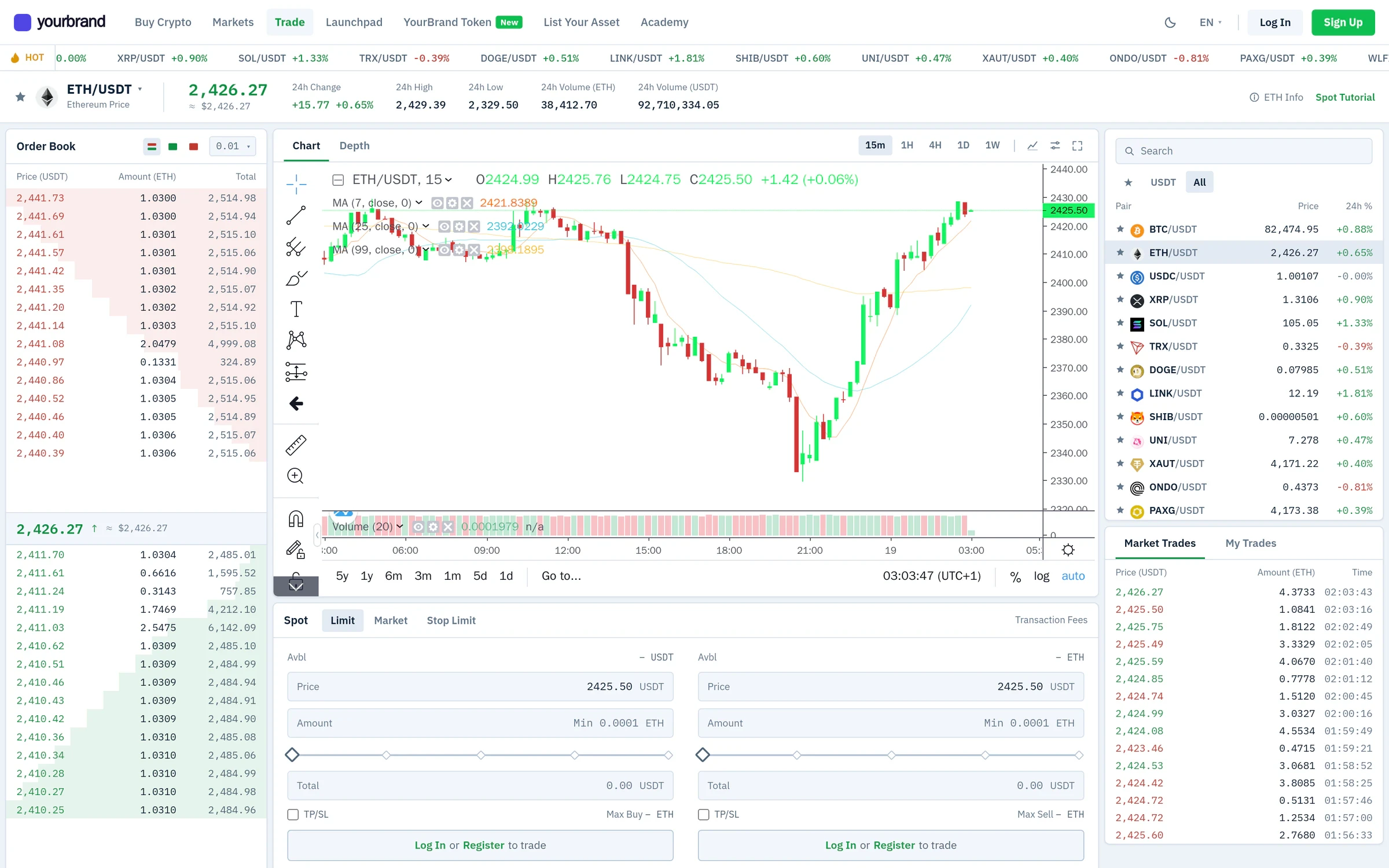
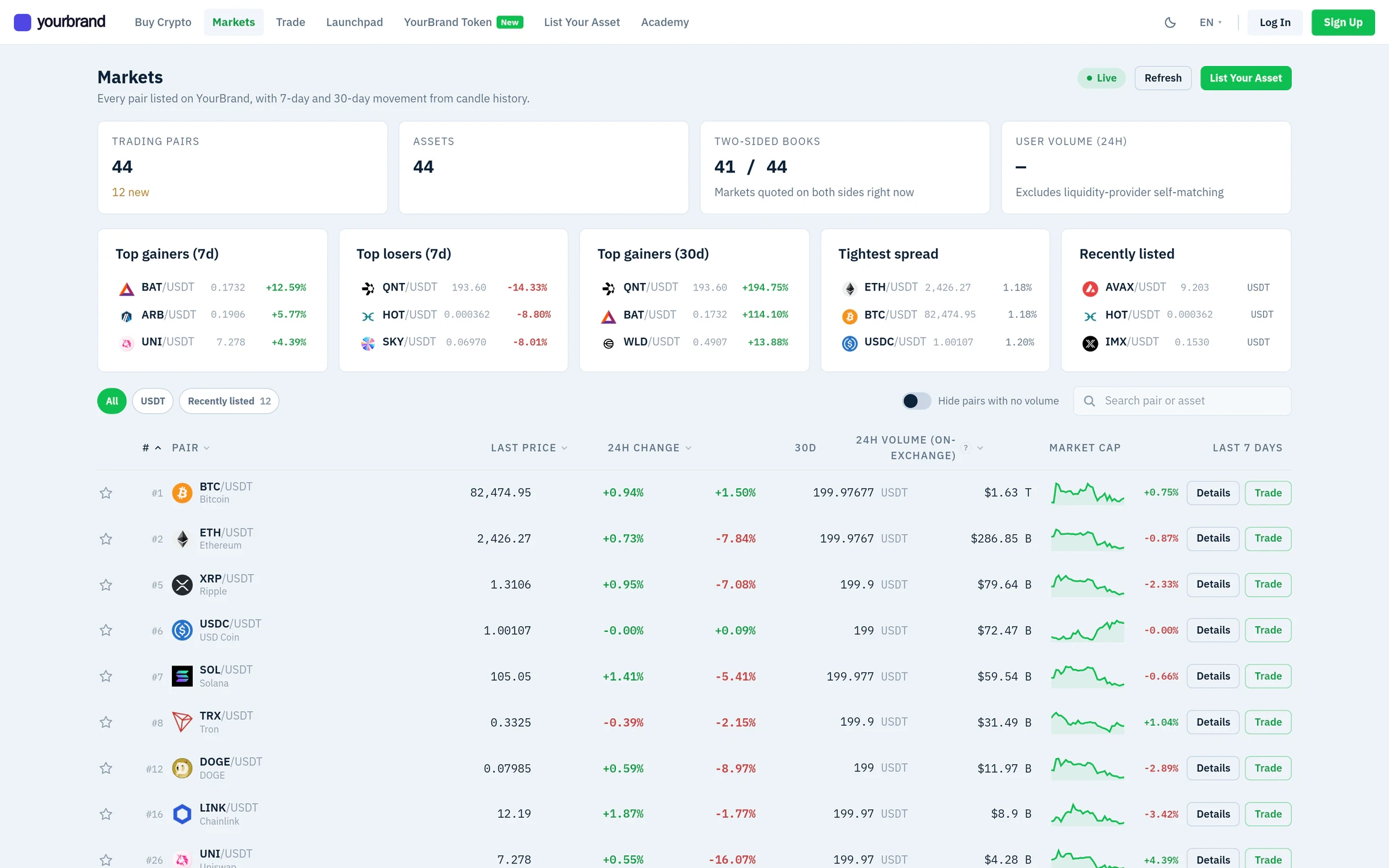
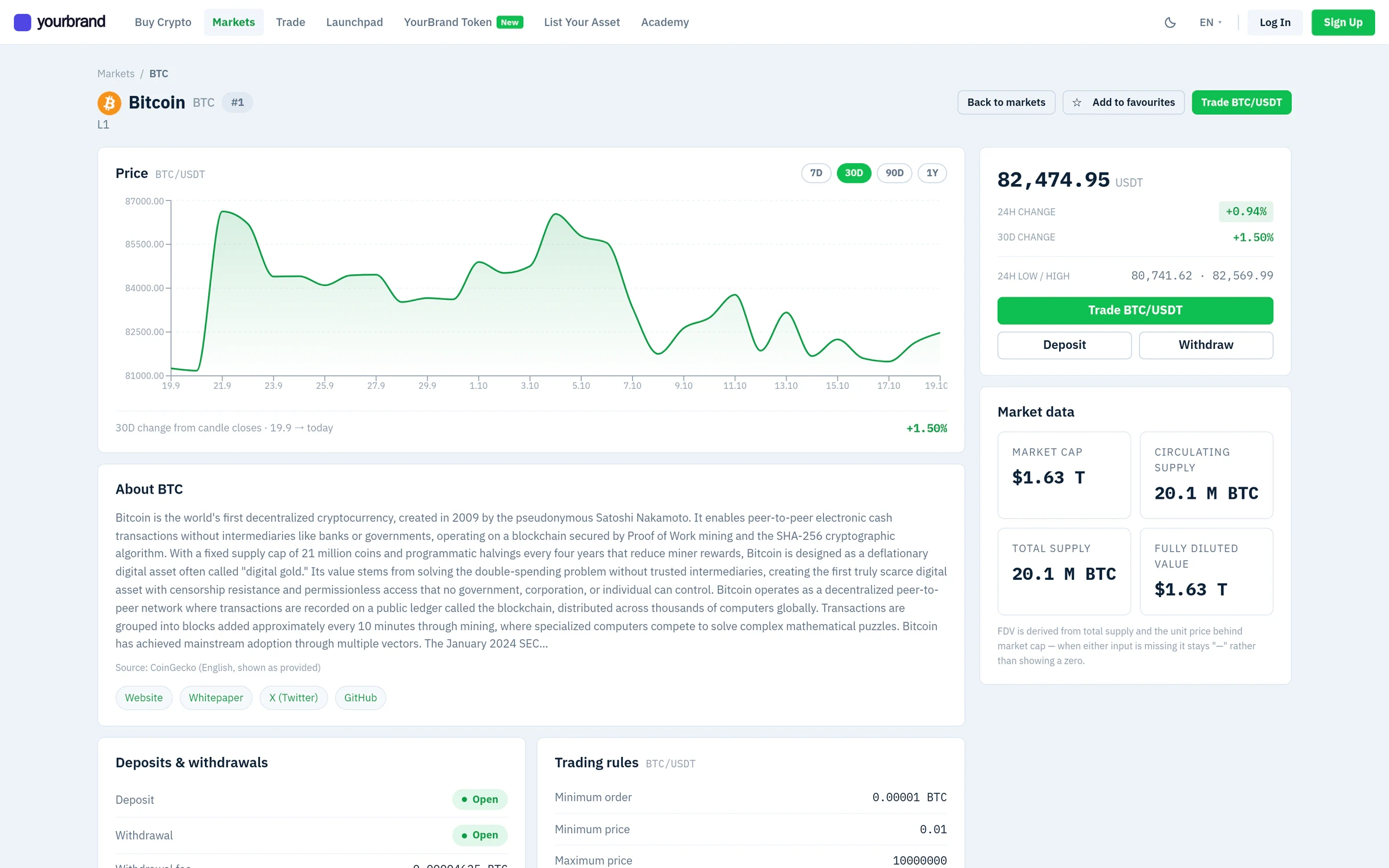
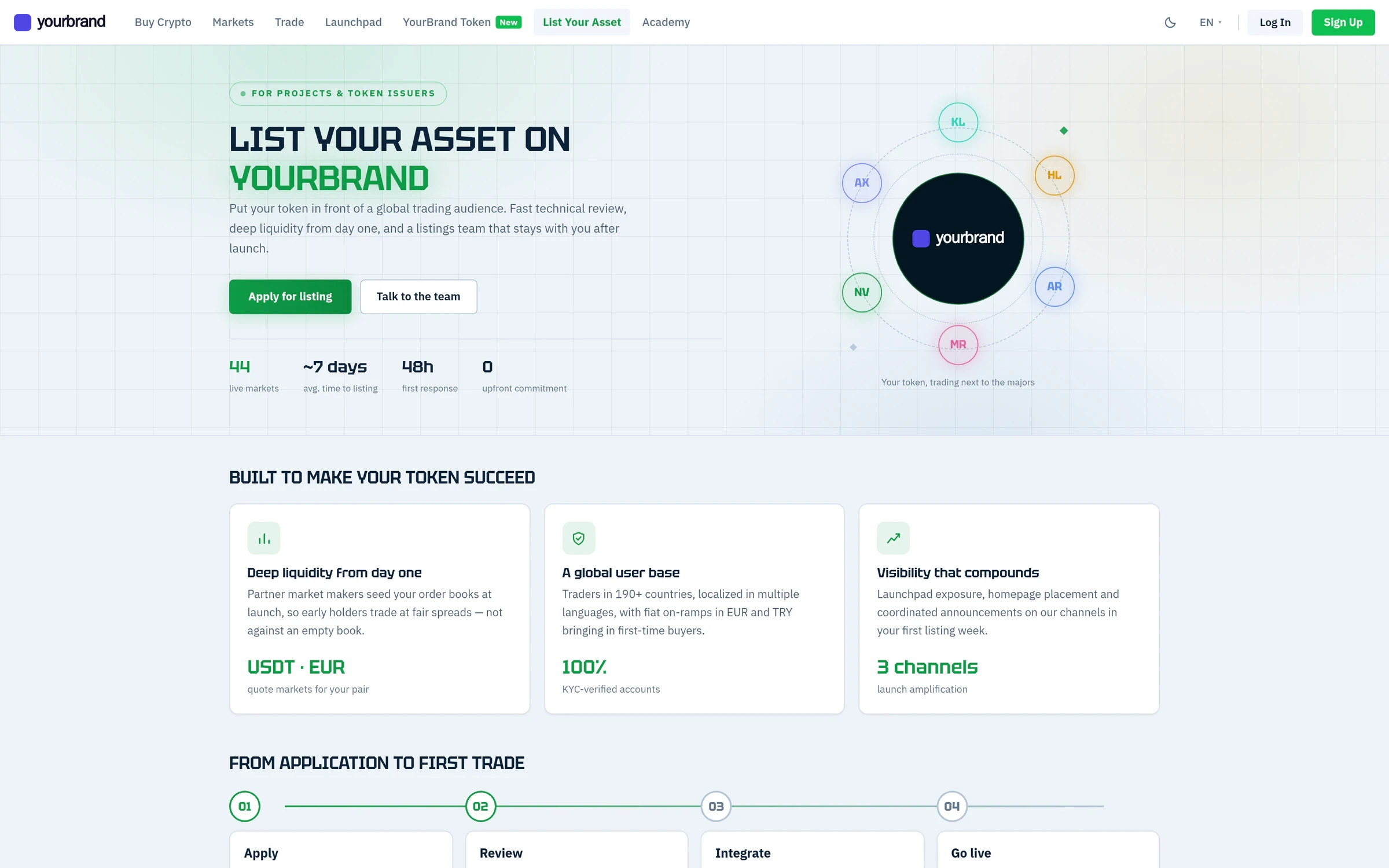
Some figures in these screens are sample data; layouts and features are the running software.
Deep order books without locking up capital.
The problem
Liquidity is a new exchange’s most expensive requirement. Filling the book with your own capital means holding inventory in every market: at default limits, 97 markets need roughly $930,000 of inventory. Adding a market does not create liquidity, it divides what you already have.
The approach
The Mirror engine reads the live order book of a reference venue, applies banding, VWAP and a markup, and builds your book from it. When a customer buys from your book, the engine opens the same position in the opposite direction on the reference venue, an orderback. Your net position stays close to zero; the profit is the markup in between.
Profit floor
The engine calculates a cost floor for every market: reference taker fee + transfer amortisation + safety buffer. If the markup falls below that floor, the market is not quoted. The panel refuses a below-floor markup outright; there is no override.
97 markets, a 20-second cycle
Source books are read in parallel; a full refresh across all markets completes in well under a second.
Open exposure queue
Every fill that could not be hedged is visible line by line: market, amount, age, attempts, reason. A fill with no funds on the reference venue is not counted as failed; it waits until funding arrives.
Credit line guard
An invariant: MM credit on the ledger ≤ actual assets on the reference venue. A balance that cannot be read is counted as unknown, never as zero.
Panic control
One button pulls all books, but the engine stays up and position tracking is not switched off.
Multi-venue
Reference connectivity through Binance and CCXT; more venues can be added as sources with their own weights.
Liquidity without inventory, in five moves.
What happens in the 20 seconds after a customer hits buy on a mirrored market.
- The engine reads the reference order book and applies banding.
- Your customer's market buy fills against the mirrored quote.
- An orderback is sent to the reference venue for the same size.
- The hedge fills; the open-exposure queue clears.
- Profit = your markup minus the taker fee · below-floor quotes are refused
Zero-capital, end to end.
1 · Deposit
The customer deposits. A buffer stays in the hot wallet; the excess is forwarded to the reference venue.
2 · Trade
The customer trades against your mirrored book.
3 · Hedge
The fill is hedged with an orderback at the moment it happens.
4 · Withdraw
The customer requests a withdrawal. Exactly what the request needs is pulled from the reference venue to the hot wallet and paid out.
Four-gate withdrawals
Automatic replenishment withdrawals sit behind four separate gates: an environment switch, engine live mode, a per-key withdrawal flag and a per-asset policy row, plus a daily USD cap per asset, a manual one-day allowance and a justified record.
TRON energy system
The largest cost of TRC-20 withdrawals is TRON energy, about 13 TRX per withdrawal if burned. The system rents energy by the hour instead: 4.7–9.3 TRX, a measured saving of 30–65%. Rental is a signed payment per transaction, no escrow, from an account entirely separate from the hot wallet.
Energy safety gates
Daily TRX cap, unit-price cap (refuses anything above the burn rate), cooldown, and fail-open design: withdrawals work even if this module is unavailable. Before the payment transaction is signed it is decoded at protocol level and who pays what to whom is verified.
Collection gas
Gas tanks that fund token collection are monitored continuously; thresholds are derived from the chain’s own fee parameters. When a tank runs dry, collection does not stop silently; it raises an alert.
Proven in production
The deposit → forward → trade → hedge → withdraw cycle ran end to end with real money.
What the operator sees.
Screens from the running system. Light theme.
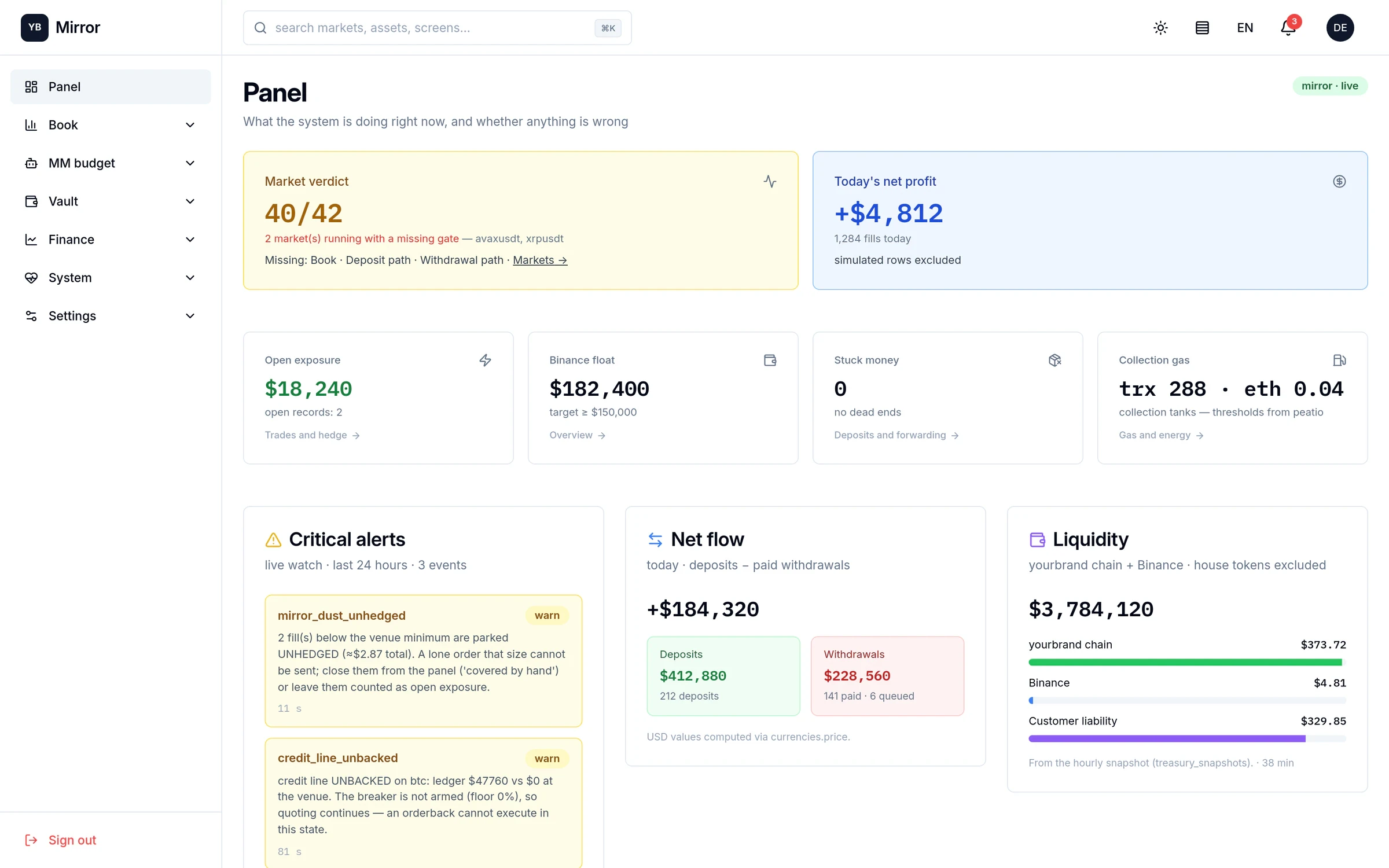
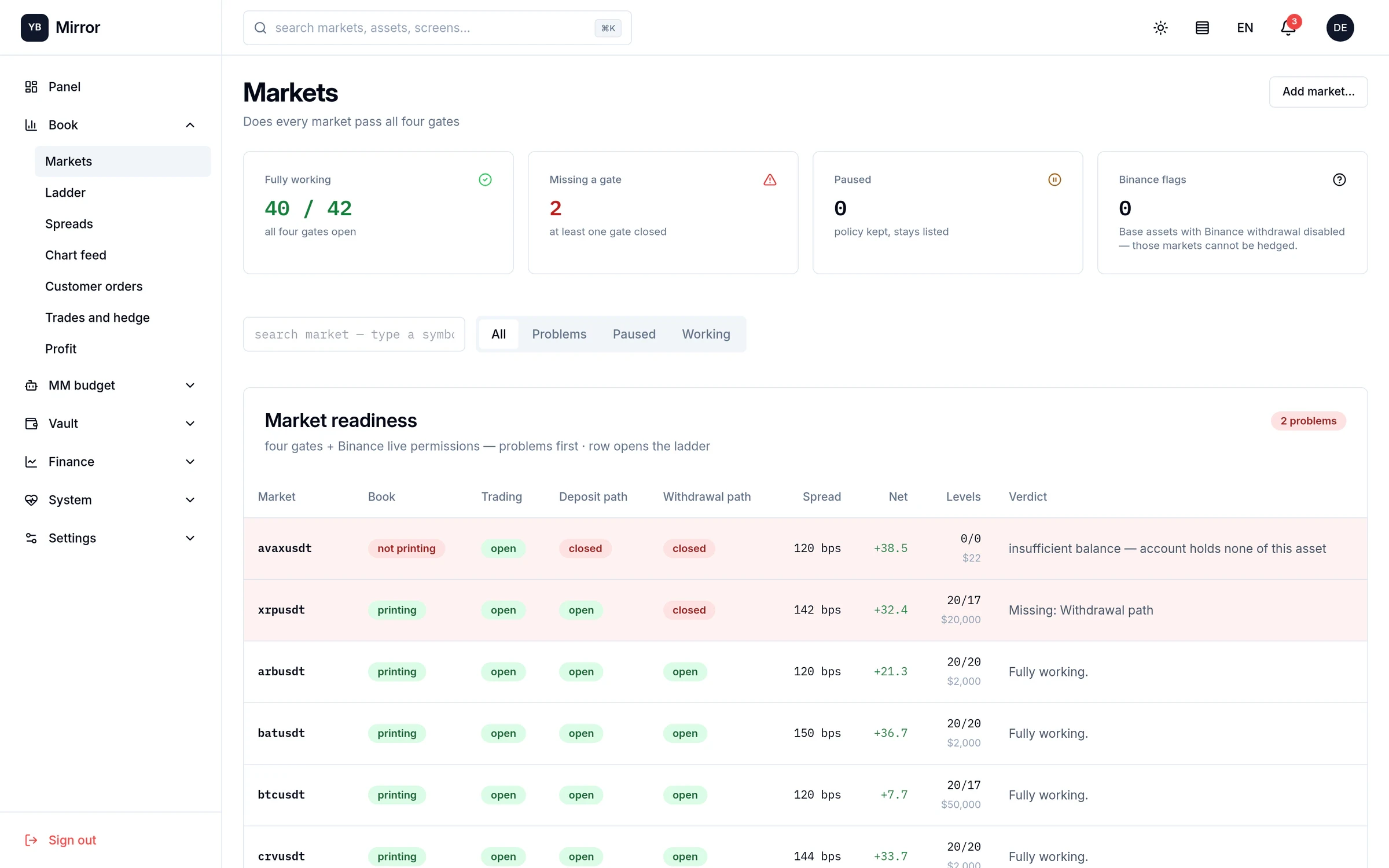
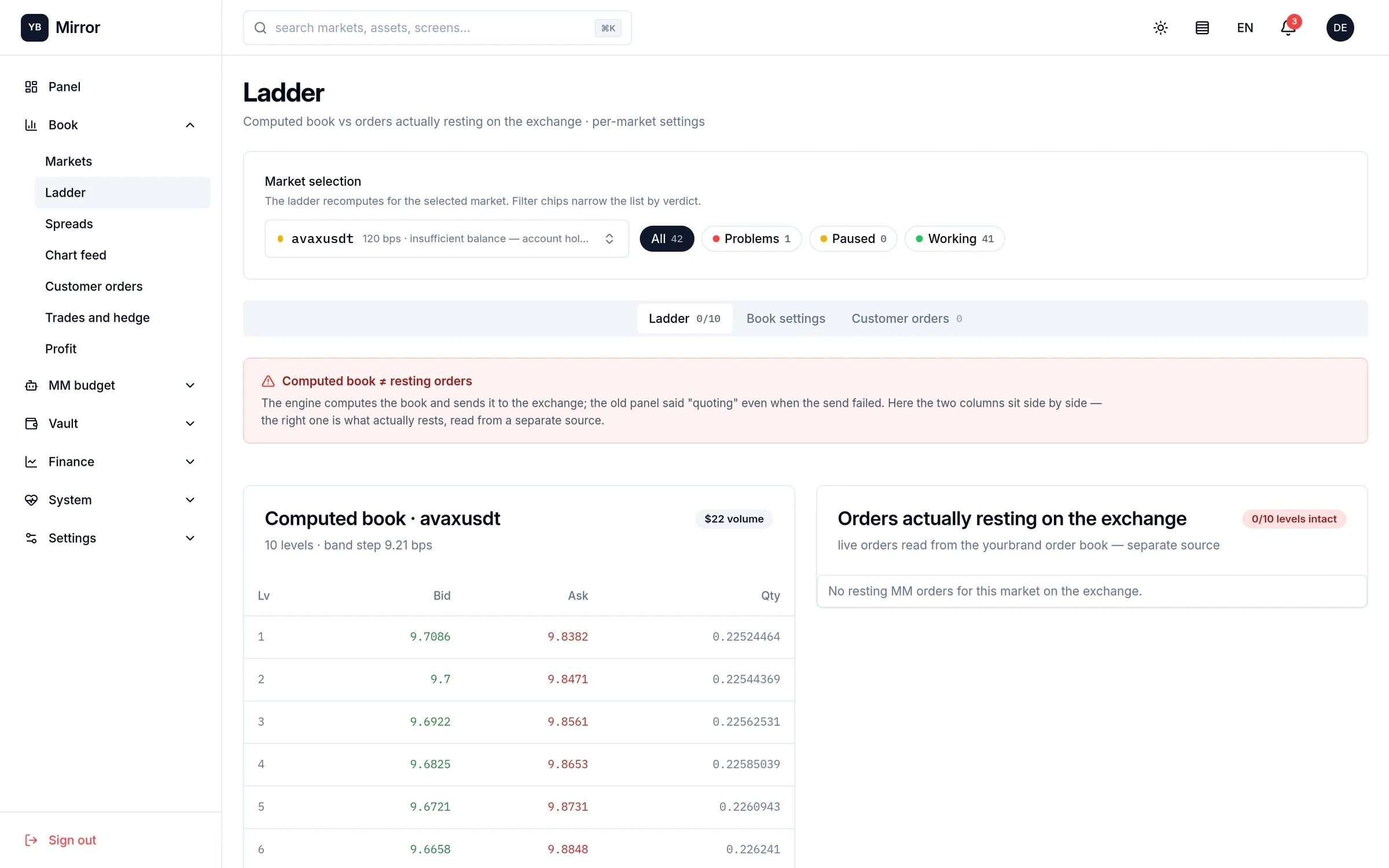
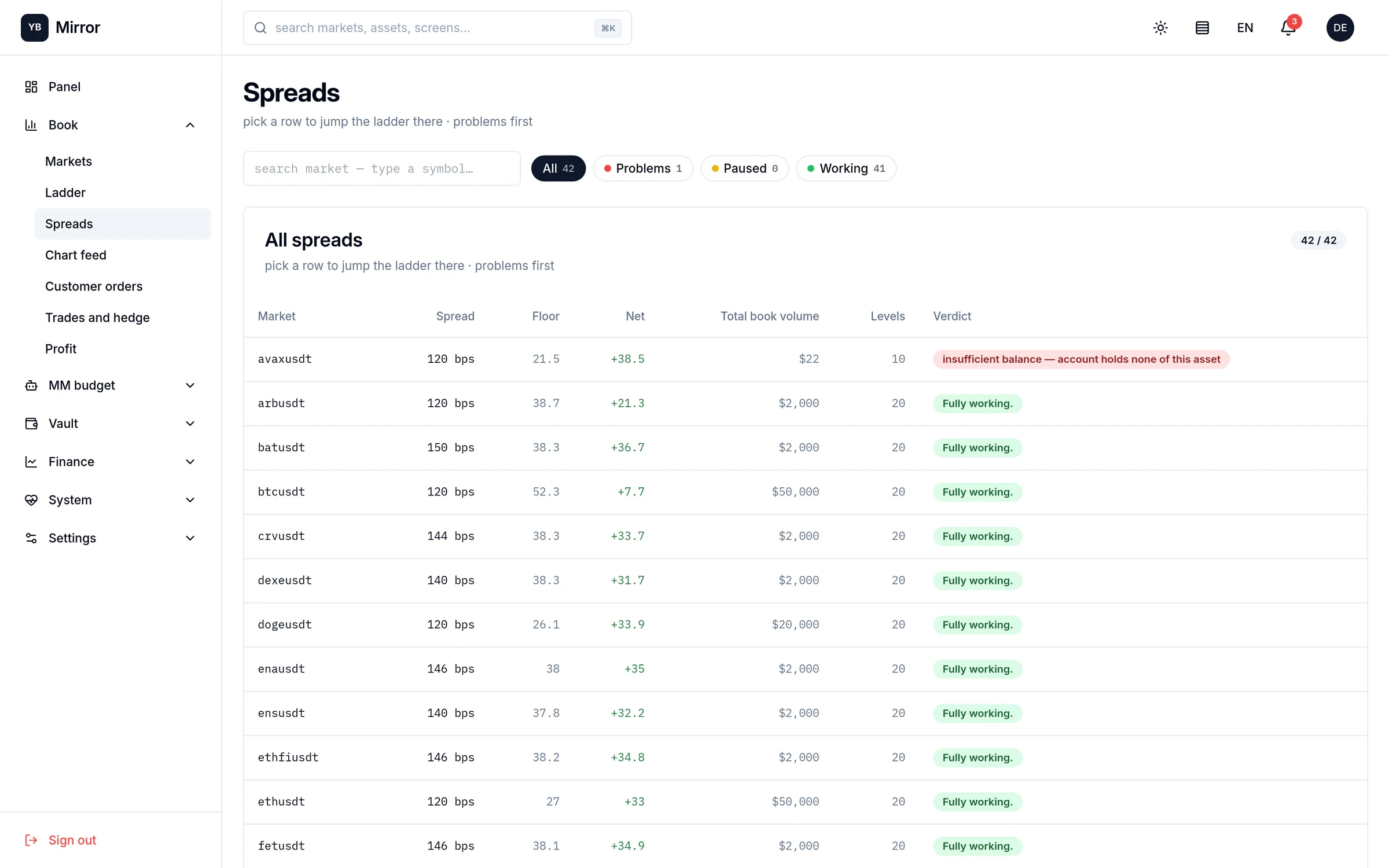
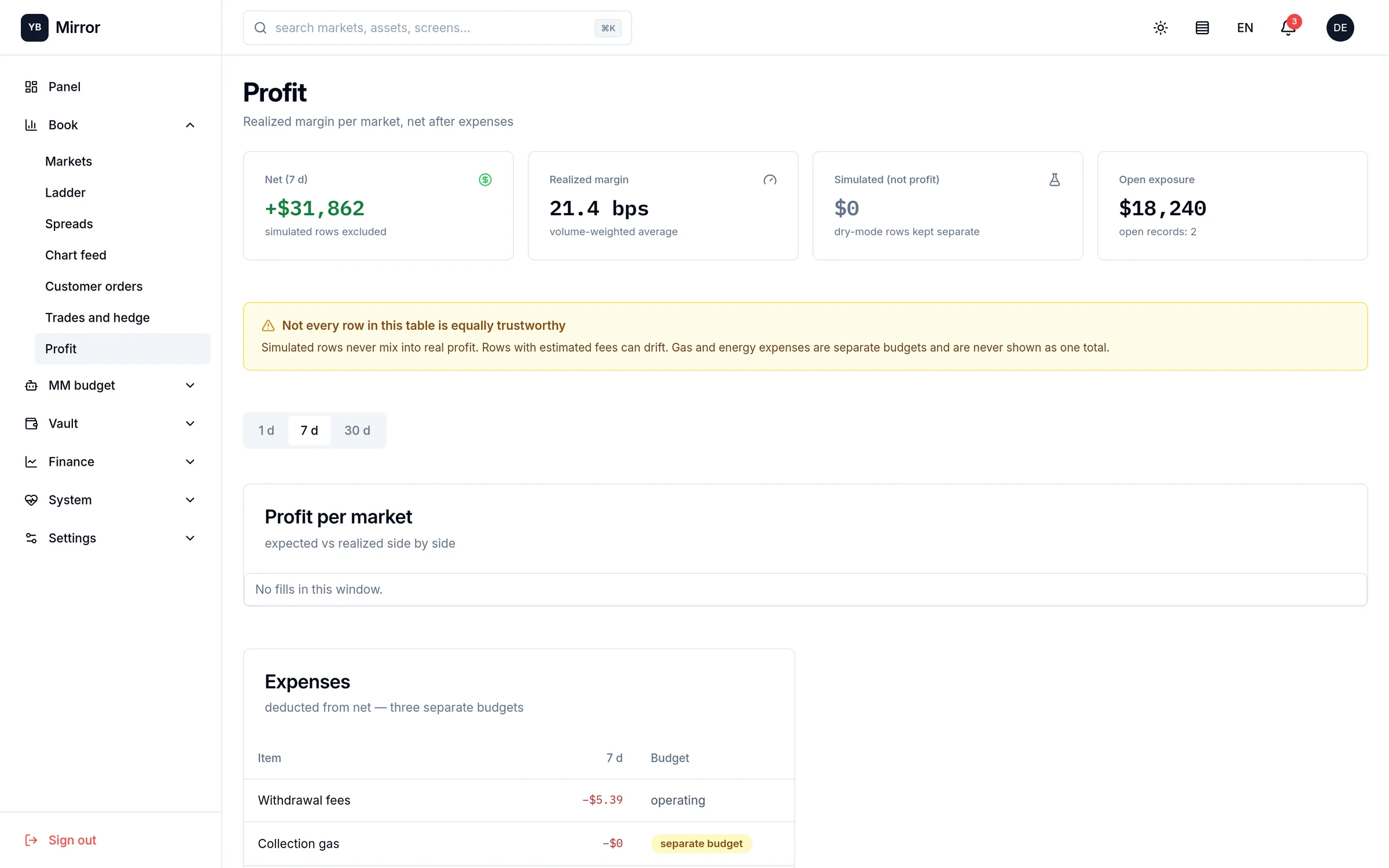
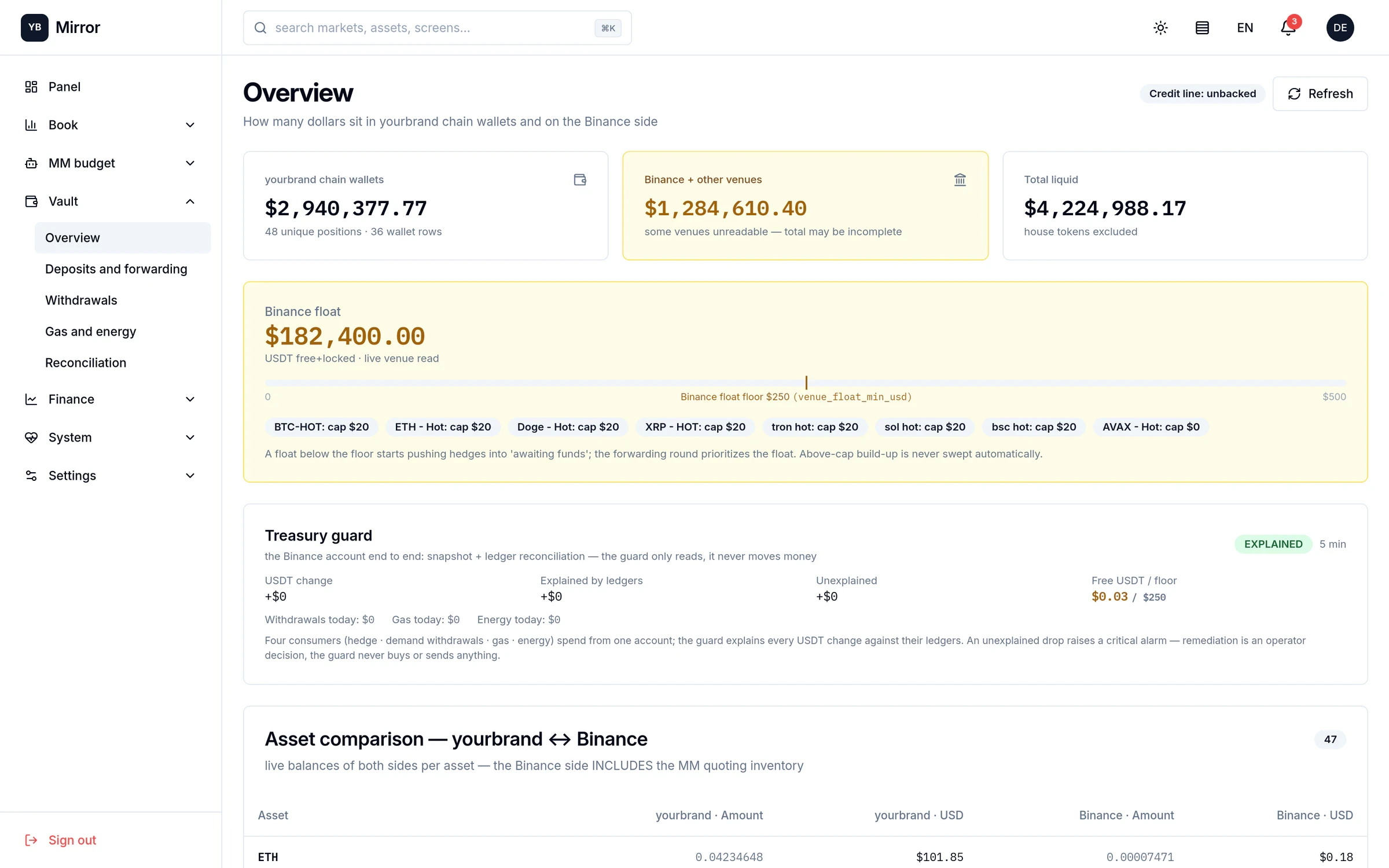
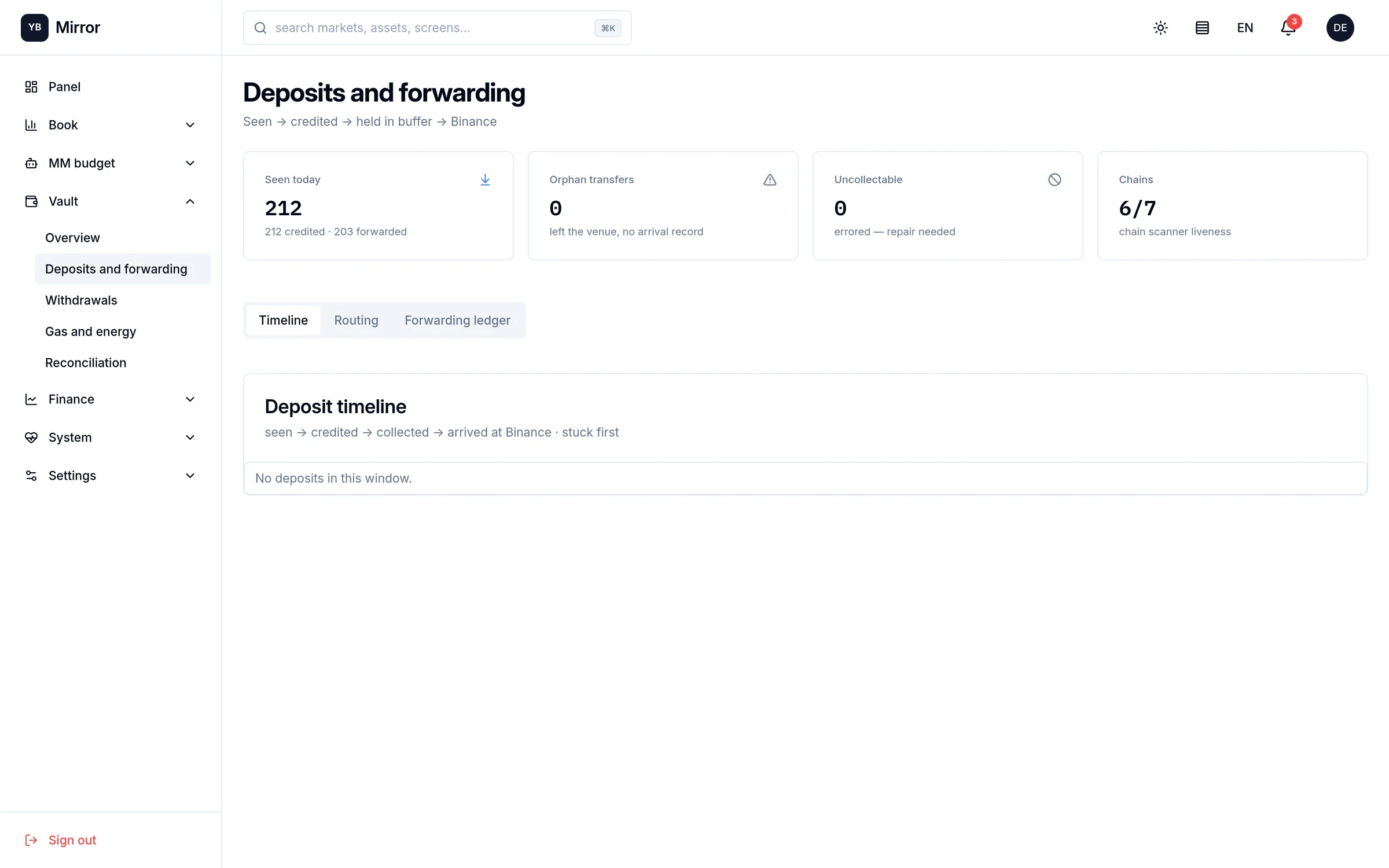
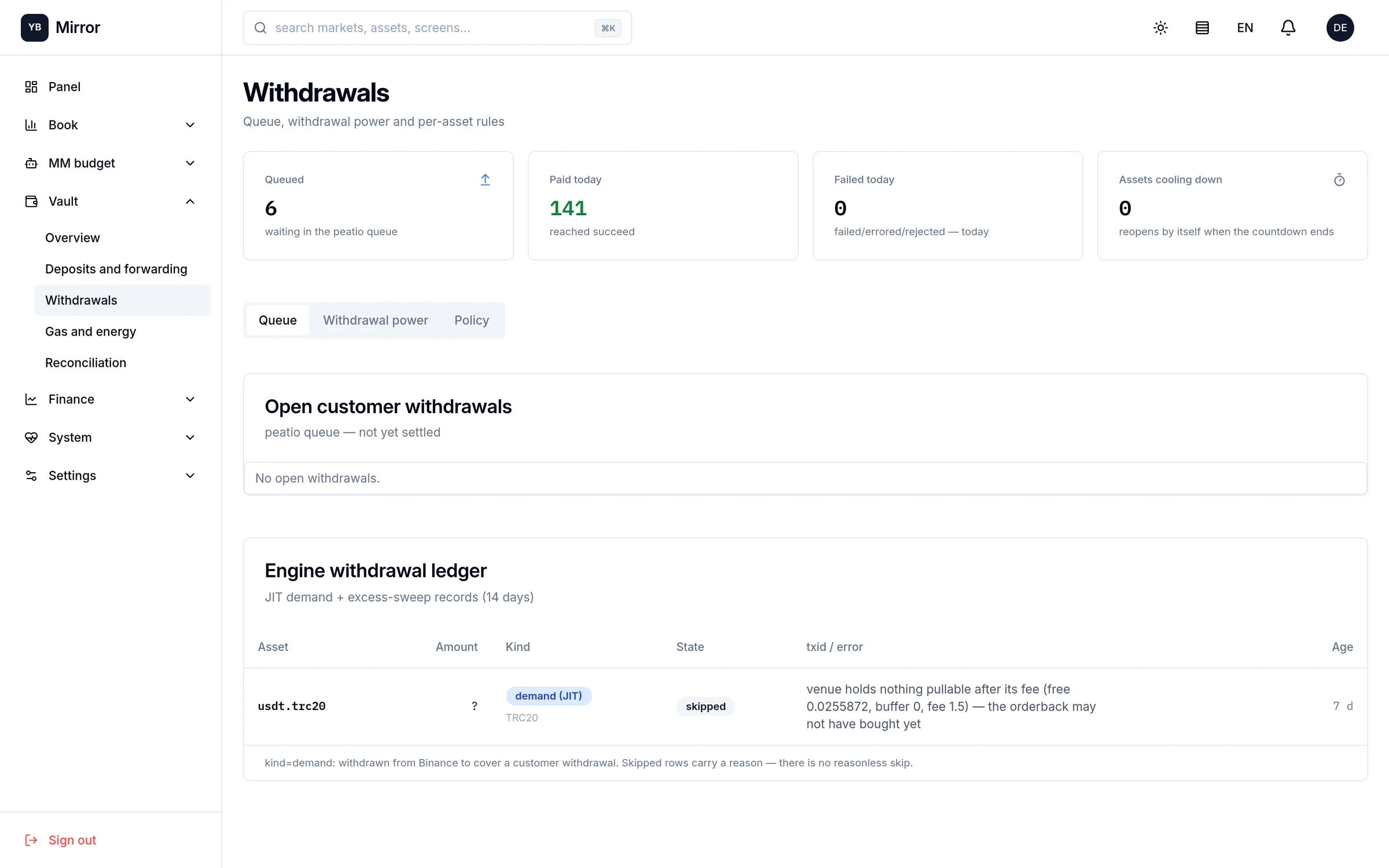
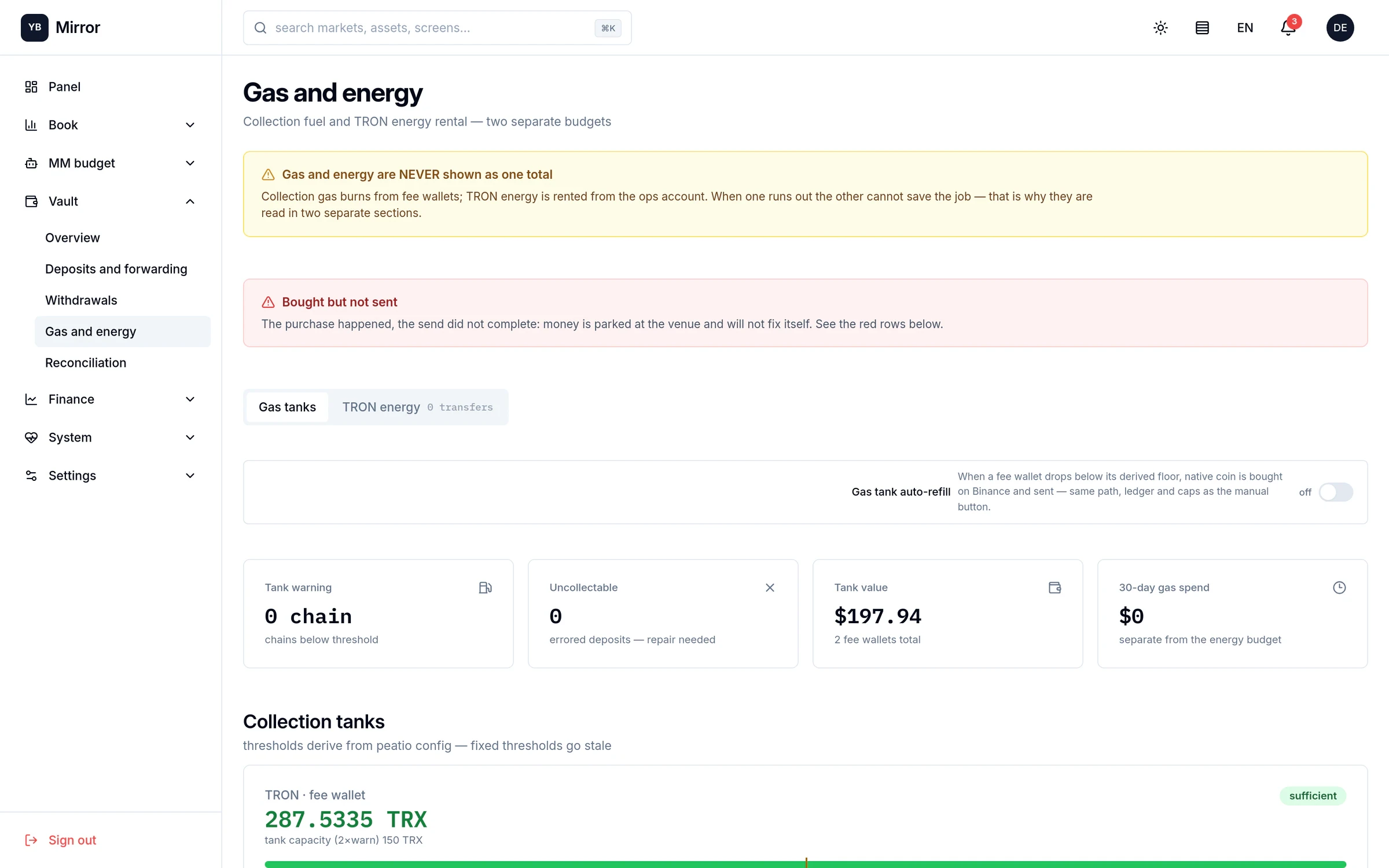
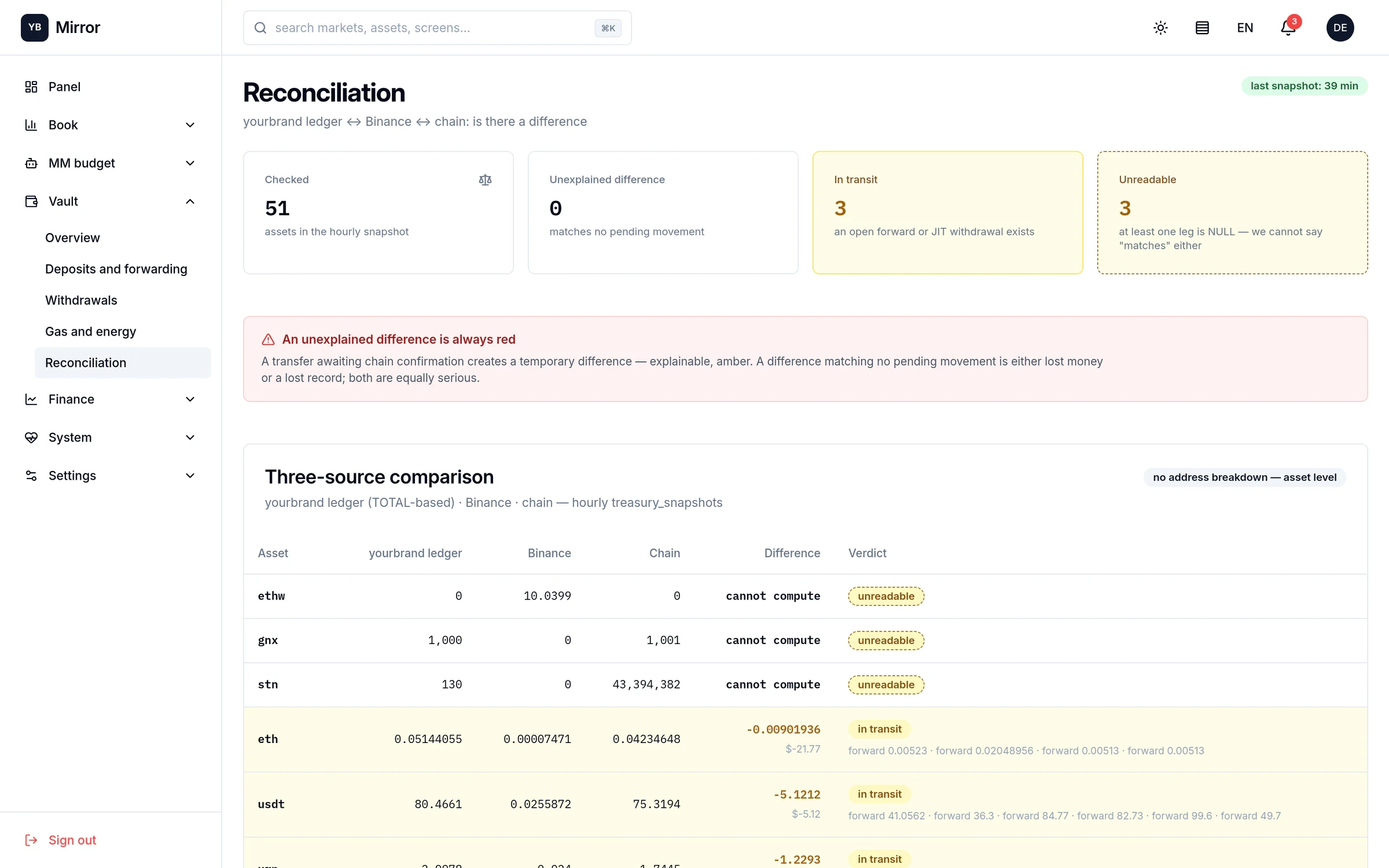
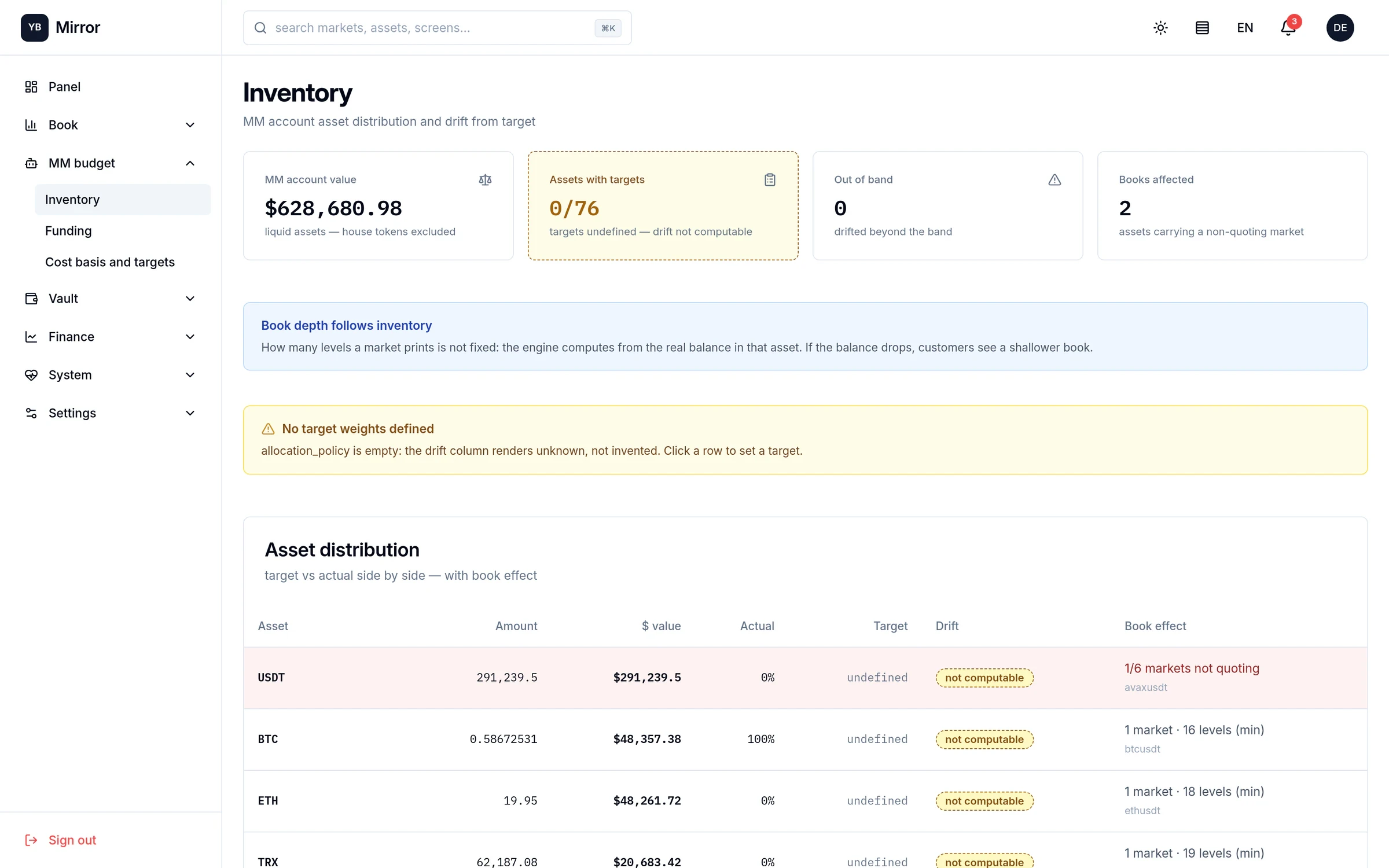
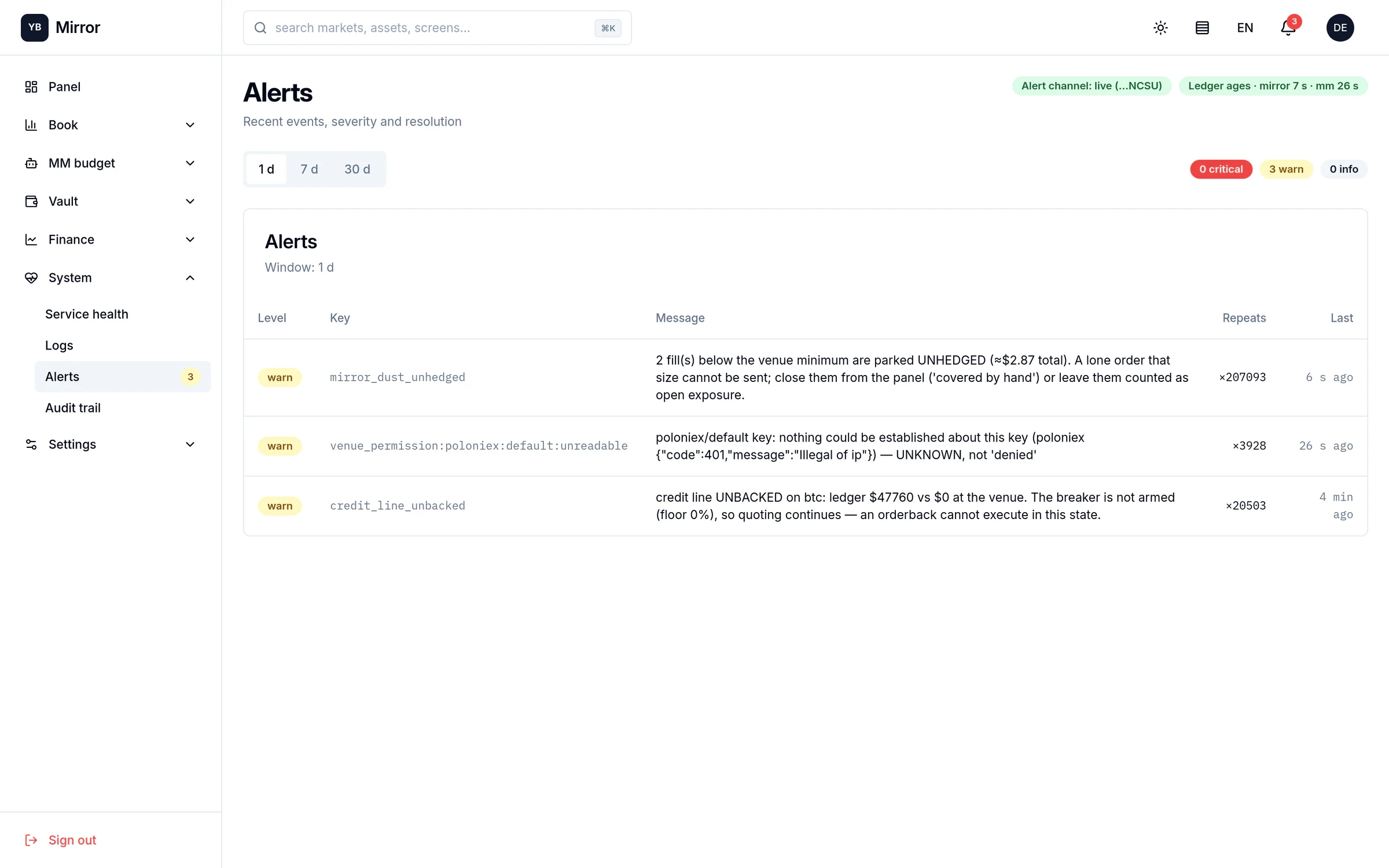
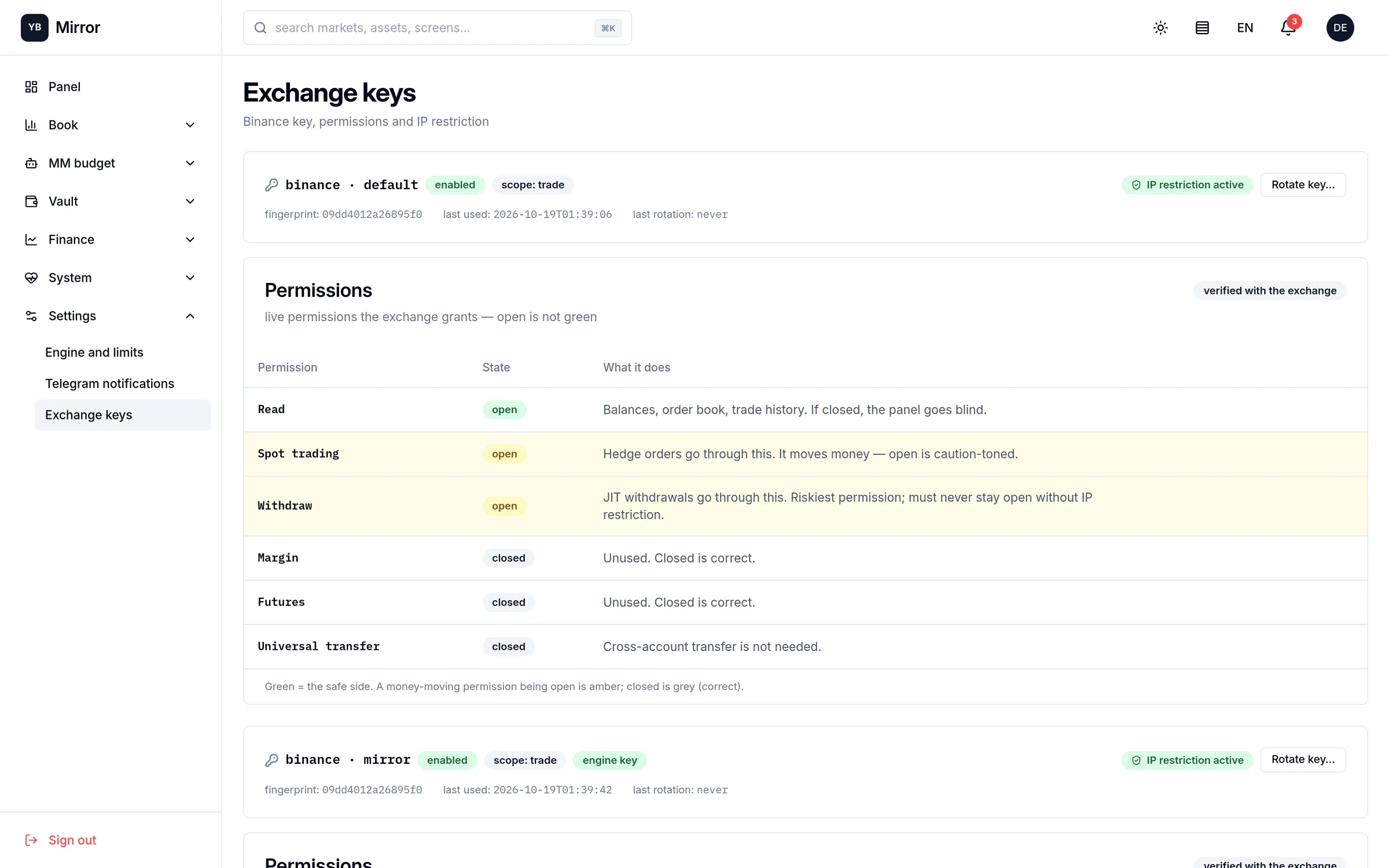
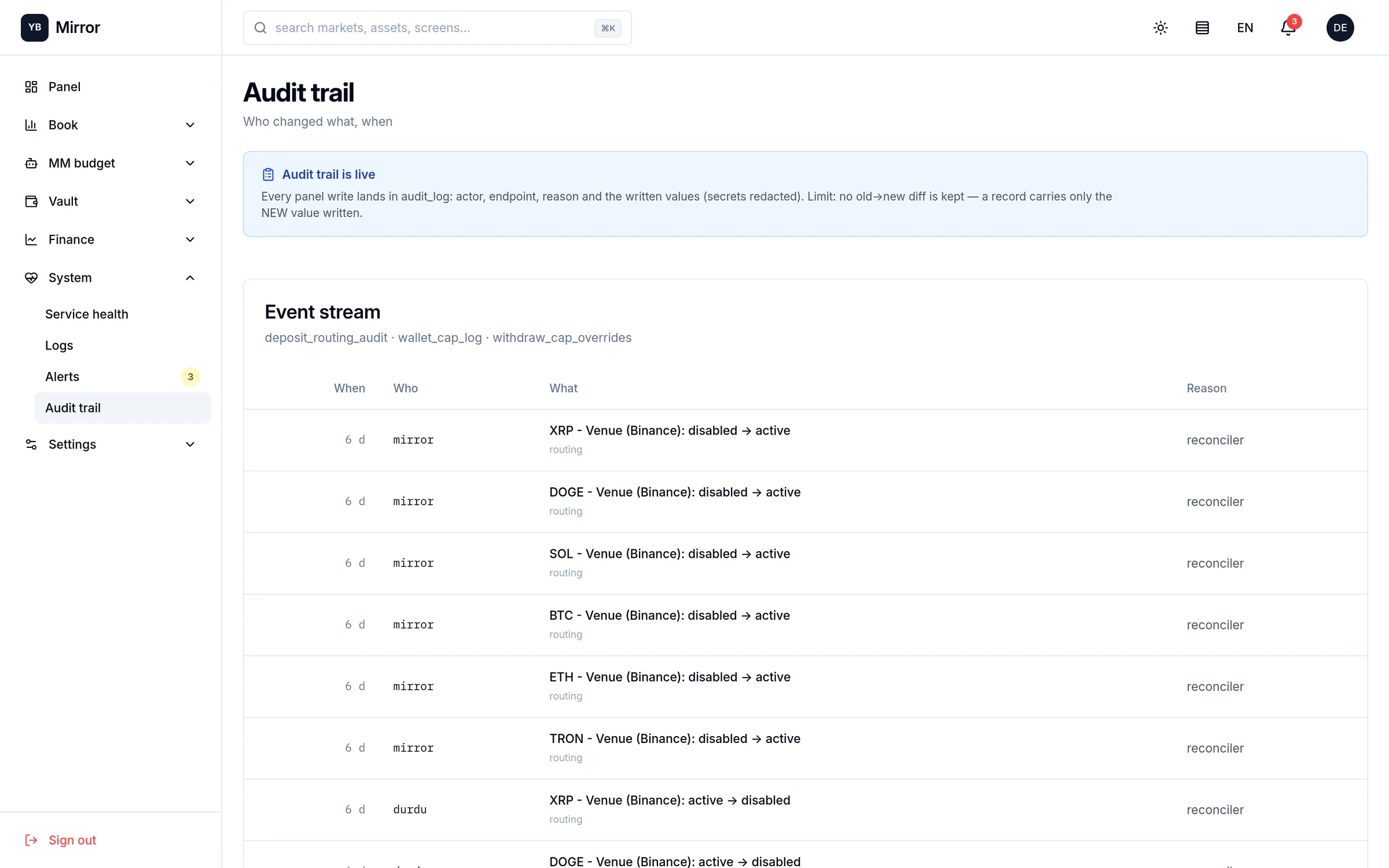
Some figures in these screens are sample data; layouts and features are the running software.
Everything else an exchange needs, already built.
Not add-ons. These ship with the Exchange and run on the same ledger, identity and custody. Details and screens in the live demo.
Easy Trade
Buy or sell in three taps for people who have never seen an order book. Same engine, same custody, no spread tricks.
Launchpad
Token distribution on your own exchange: rounds, allocations, vesting, listing.
Earn
Flexible and fixed-term reward programmes with operator-set terms and caps, switched on only where your licence allows.
Rewards & alerts
Referral, tasks, price alerts and push; the reasons a customer comes back.
iOS & Android apps
Native, already through store review, published under your developer account.
Operations console
53 screens for the team that runs it: KYC queue, treasury approvals, support, reports, audit.
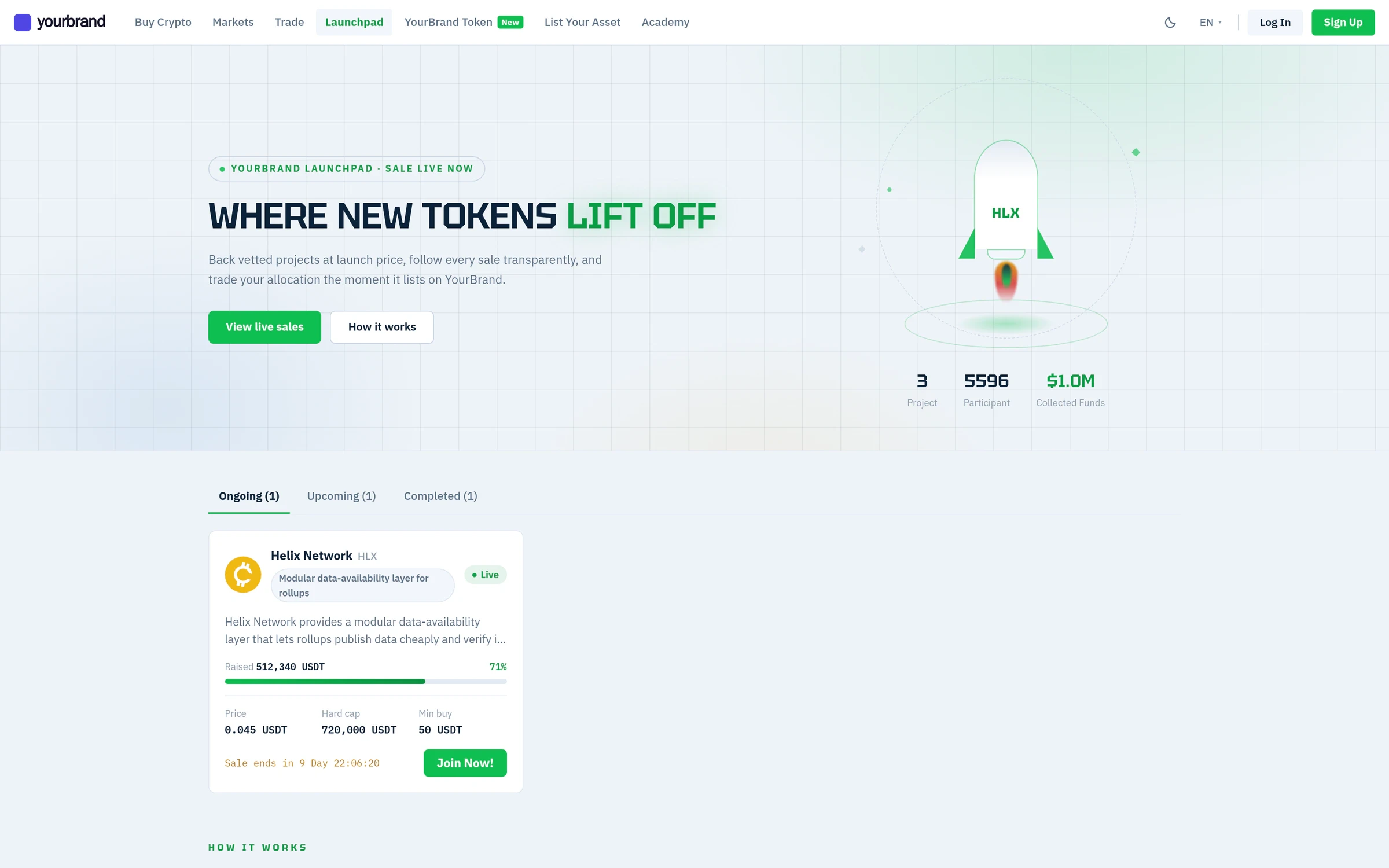
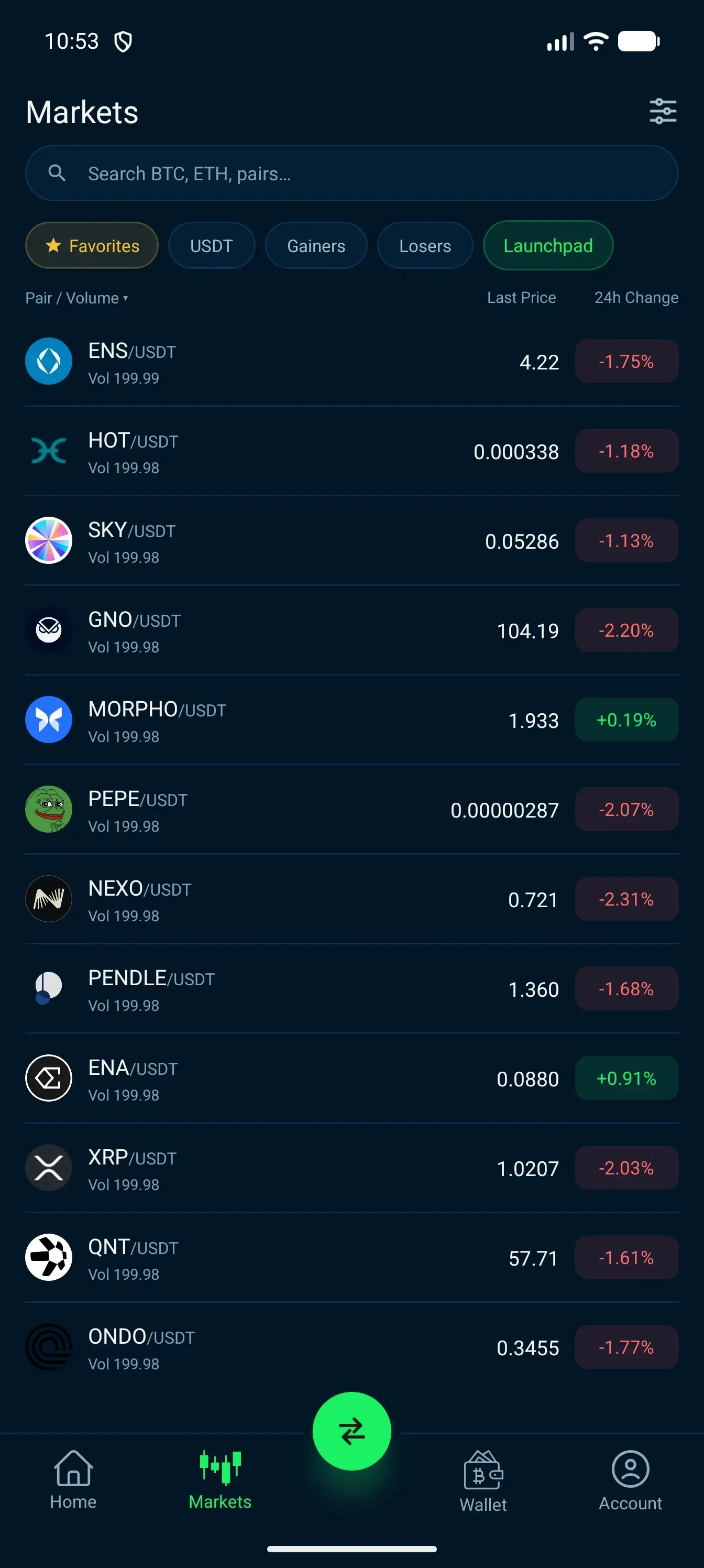
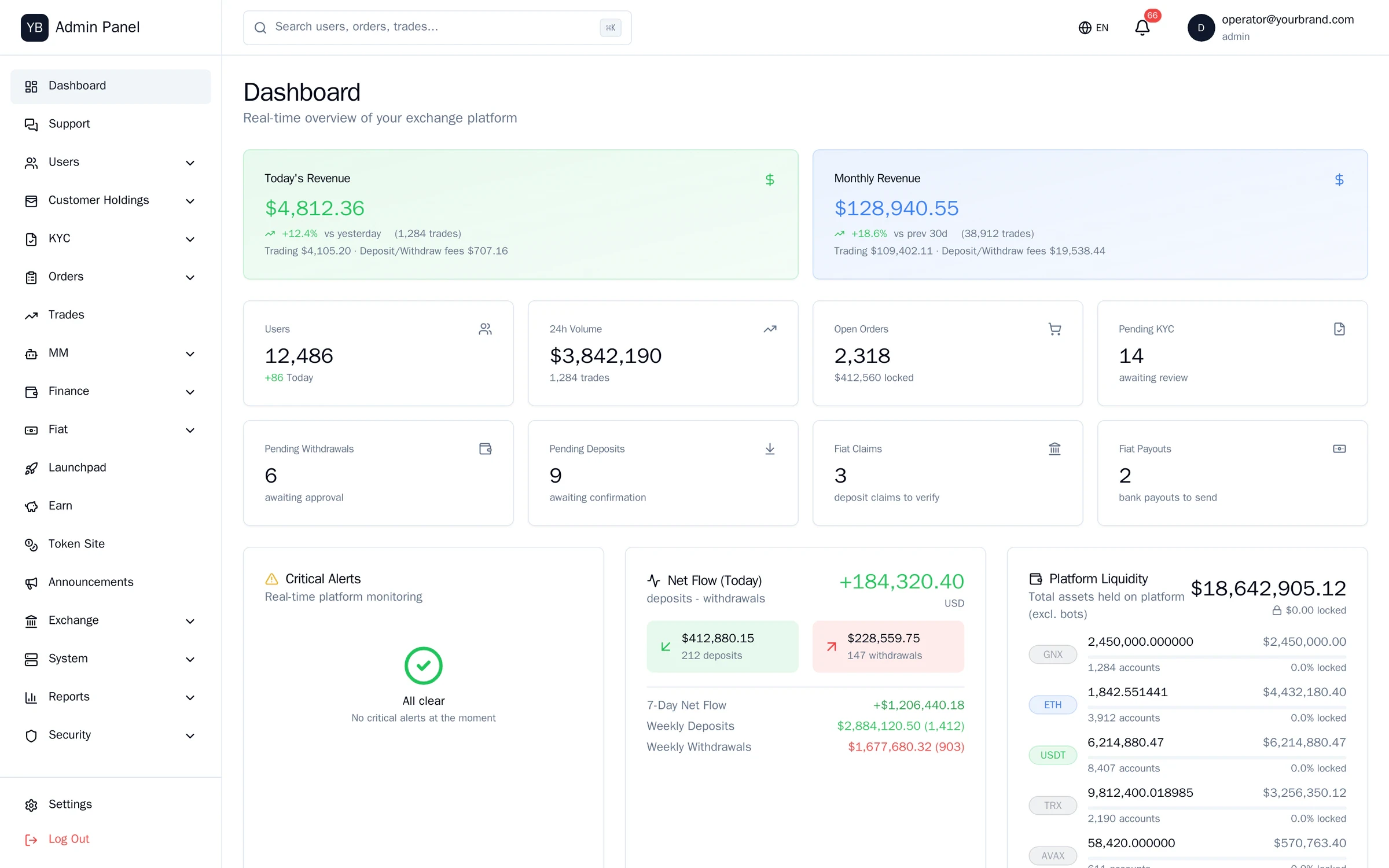
Everything in the box. Shown live, not described.
The list is long because the product has run an exchange for years. Each line is a working screen in the demo; we walk through the ones that matter to you on the scoping call.
See each one running: 150-screen tour, testnet account, console with write access in a guided session.
Trading
- Spot order book, limit / market / stop
- Easy Trade (3-tap buy & sell)
- 97 markets, operator-listed pairs
- TradingView charts, depth, trades
- Maker / taker fee tiers
- Price alerts & push
- Open orders, history, statements
Liquidity
- Mirror engine: mirrored books from reference venues
- Orderback hedging per fill
- JIT funding cycle
- Per-market cost floor
- Open-exposure queue
- Credit-line guard
- Panic control
Growth
- Launchpad: rounds, allocations, vesting
- Earn: flexible & fixed-term
- Referral & task rewards
- Promotions & announcements
- Content platform: academy, glossary, market pages
- SEO-ready, 7 languages
Customer
- KYC tiers (Sumsub / Didit)
- 2FA, device & session control
- Fiat deposit / withdrawal via PSP & bank
- Crypto deposit / withdrawal, address book
- Address Shield checks
- API keys, statements, tax export
- Support chat & tickets
Mobile
- Native iOS & Android
- Markets, pro trade, pair selector
- Wallet, deposits, withdrawals
- Biometric login
- Push notifications
- Published under your developer account
Operations · 53 screens
- Dashboard, users, KYC queue
- Deposits, withdrawals, approvals
- Ledger, stuck funds, reconciliation
- Markets, currencies, fees
- Mirror / Earn / Rewards consoles
- Reports: financial, user, volume
- Roles, permissions, audit log
Custody & security
- Hot / warm / cold tiers
- Policy engine, approver quorum
- HSM integration on request
- Reserve monitor & PoR export
- Chain scanners, TRON energy rental
- Backups, restore drills
- DORA control mapping
Deployment
- Cloud, self-hosted or source
- Hetzner / AWS / on-prem
- Cloudflare edge
- Staging + production
- Release notes & changelog
- Technical file for licensing
Exchange at a glance
- Matching
- matching engine (Go): spot matching, gRPC and AMQP transport · limit, market, stop-limit · self-trade prevention
- Liquidity
- Mirror engine on 97 markets · JIT zero-capital cycle · Binance + CCXT sources · your own market makers via API
- Core
- ledger service (Rails): wallets, accounting, transfers · identity service + Sumsub v2 · WebSocket feeds + API gateway
- Clients
- React SPA (TR/EN/PL) · React Native 0.78 iOS + Android · mobile web
- Operations
- 53-screen admin · Mirror console · Earn console · live support · 60 email templates (TR/EN/RU/PL)
- Chains
- BTC, ETH, BSC, TRON, XRP, SOL, DOGE, LTC, AVAX C-Chain · RPC pools with failover
- Infrastructure
- ~50 services in Docker Compose · Traefik · Cloudflare · MySQL, Redis, InfluxDB, RabbitMQ, Vault
- Deployment
- White-label cloud · self-hosted · source code · 5 weeks to launch
- Pricing
- Cloud from €1,600 / mo + setup · self-hosted €24,500 · source €58,100 — build an estimate
Scope your exchange.
Markets, fiat rails, languages, deployment model. A written proposal within a week of the first call.